The architectural presentation has undergone a seismic shift. Where architects once relied exclusively on static 2D blueprints and pre-rendered offline stills, modern spatial visualization now operates in real-time, high-fidelity interactive 3D simulations.
At HORIZON X, our 3D walkthrough pipeline leverages cutting-edge game engines, real-time ray-tracing, and volumetric lighting to construct millimeter-precise digital twins, allowing clients and developers to walk through, evaluate, and emotionally connect with spaces years prior to groundbreaking.
01 The Evolution of Architectural 3D Walkthroughs
Traditional architectural visualization was historically constrained by long offline render queues and rigid, non-interactive camera paths. If a stakeholder wanted to inspect a different viewing angle or assess daylighting at twilight, days of re-rendering were required.
With modern real-time GPU pipelines, spaces become live, reactive environments. Users can freely traverse hallways, manipulate daylight angles in real-time, test alternative material finishes instantaneously, and experience accurate spatial acoustics.
02 Real-Time Rendering Engines & Digital Twin Fidelity
Photorealism in real-time requires deep technical mastery of physics-based rendering (PBR), dynamic global illumination, and high-density geometry streaming. Subsurface scattering on marble surfaces, accurate index-of-refraction reflections on coated glass, and volumetric atmospheric fog combine to produce an indistinguishable facsimile of reality.
Technological Pillars of Photoreal Immersion
- Dynamic Ray Tracing: Physically accurate light bounce, soft contact shadows, and reflections.
- Sub-Millimeter CAD Translation: Direct conversion of BIM/Revit architectural data without fidelity loss.
- Environmental Simulation: Dynamic solar tracking, seasonal weather variations, and contextual foliage physics.
03 Interactive Spatial Exploration & Virtual Navigation
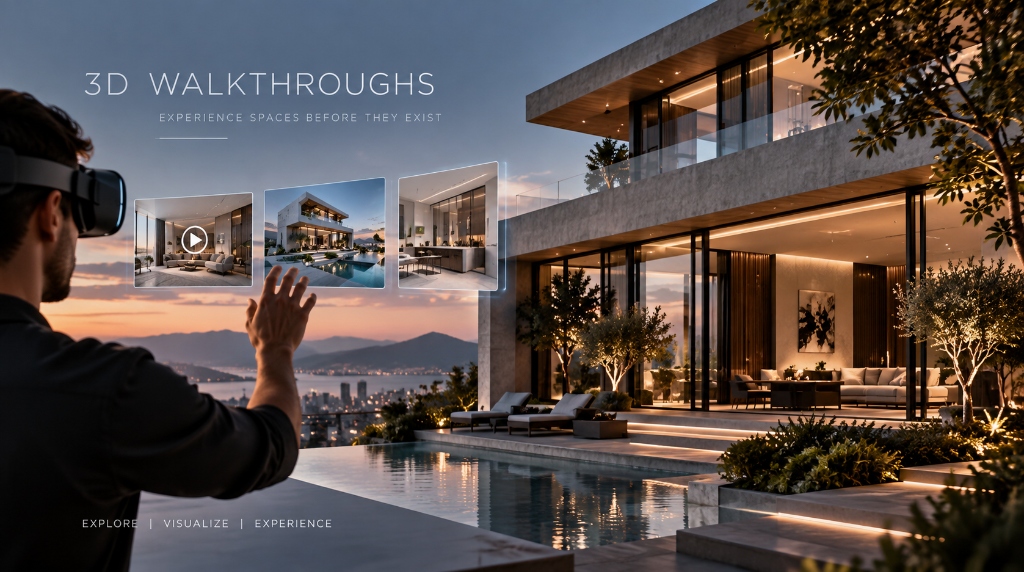
Virtual walkthroughs bridge the cognitive gap between technical schematics and human perception. Clients can navigate complex mixed-use developments, luxury residential villas, and commercial hospitality venues on desktop, touch displays, or VR headsets.
Interactive controls enable real-time toggling of furniture configurations, cabinetry wood species, and accent lighting scenes, transforming presentations into collaborative workshops.
"Real-time 3D walkthroughs transform architectural visualization from a passive viewing exercise into an active, emotional exploration of unbuilt space."
— HORIZON X SPATIAL LABS
04 Empowering Client Confidence & Rapid Decision-Making
For property developers and luxury homeowners, spatial ambiguity carries substantial financial risk. Interactive walkthroughs eliminate costly on-site change orders by validating scale, sightlines, and finishes during early concept phases.
Commercial real estate marketing teams leverage these digital twins to pre-lease premier commercial properties and secure residential off-plan sales before construction commences.
05 The Future of Immersive Digital Twins
As neural rendering, cloud pixel streaming, and spatial computing headsets mature, architectural walkthroughs are becoming omnipresent. Stakeholders worldwide can participate in synchronous multiplayer walkthroughs from web browsers without requiring specialized hardware.
At HORIZON X, we continue pushing the boundaries of what is possible at the intersection of architecture, computing, and visual art.